
A 26-year-old Odessa man died after his pickup truck struck the back of an 18-wheeler on South Highway 385. According to the Odessa Police Department, the 18-wheeler was slowing to turn left when the northbound pickup hit it from behind. The driver, Bryan Torrez, was taken to Medical Center Hospital, where he was pronounced dead.
Police said their investigation found Torrez failed to control his speed. That finding matters, but it is not the end of every question a family may have. This page collects what has been reported, what records typically matter after an 18-wheeler crash in Odessa, and where families can request those records themselves.
Confirmed facts about the Highway 385 crash in Odessa
- When: About 6:31 p.m. The City of Odessa’s release, posted October 1, 2026, gives the date as October 1. KMID and Yourbasin reported the crash happened Wednesday evening, which was September 30. We have not been able to confirm which date is correct.
- Where: The 3000 block of South Highway 385 in Odessa, near Baiza Drive, just north of Loop 338.
- Vehicles: An 18-wheeler and a red Dodge Ram 1500 pickup, both northbound.
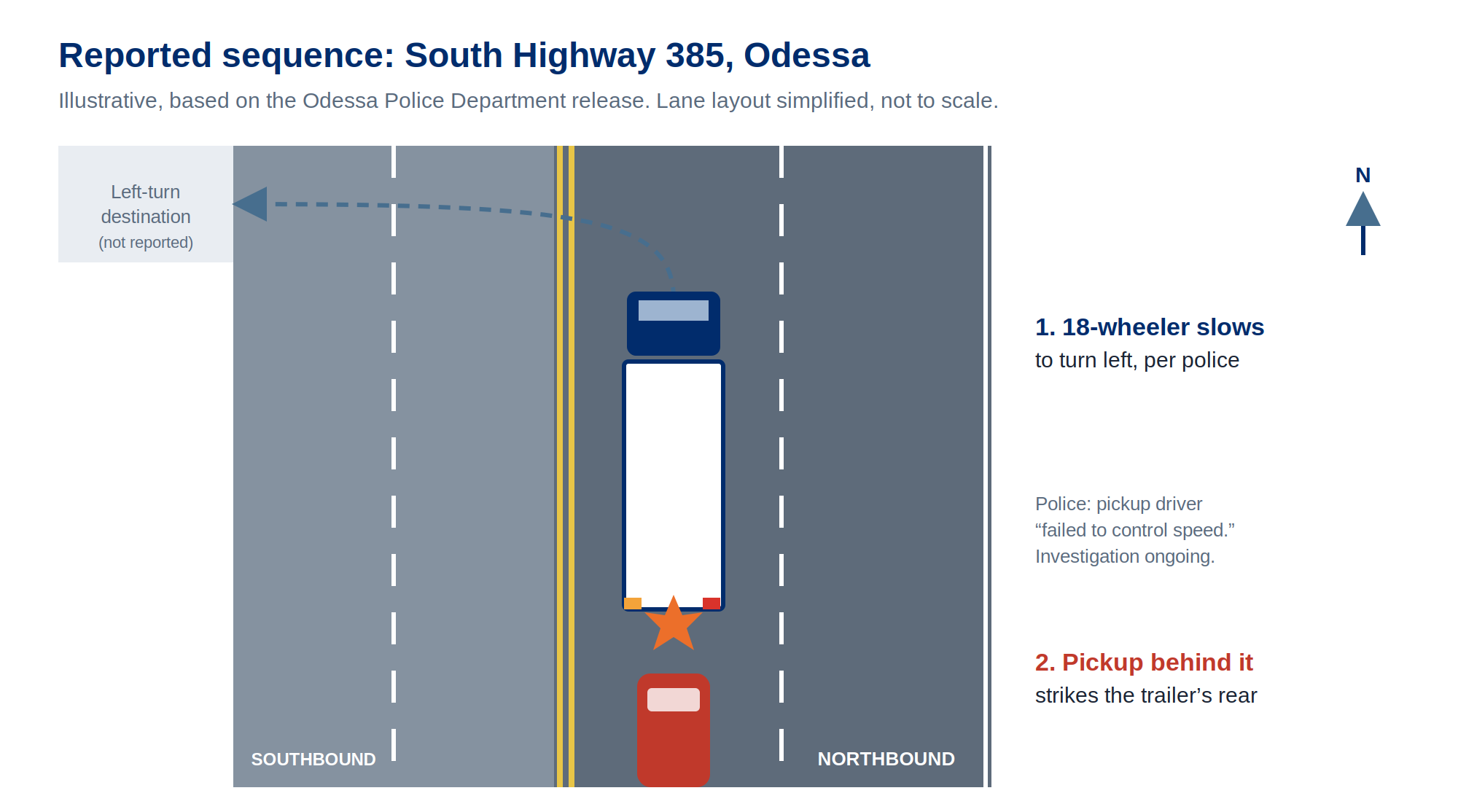
- What happened: Police said the 18-wheeler was slowing to turn left when the pickup, traveling directly behind it, struck its rear.
- Fatality: Bryan Torrez, 26, the pickup’s driver, was taken to Medical Center Hospital and later pronounced dead.
- Police finding: “Investigation revealed that Torrez failed to control speed and struck the back of the 18-wheeler,” according to the Odessa Police Department.
- Traffic: CBS7 reported the crash closed northbound lanes of Highway 385.
- Investigation: Ongoing, according to police. Next of kin have been notified.
- Not confirmed: The trucking company’s name and DOT number, where the 18-wheeler was turning, whether the truck driver was hurt, the truck’s speed, and whether any citation was issued.
Sources: City of Odessa / Odessa Police Department, October 1, 2026; KMID and Yourbasin, CBS7, and NewsWest 9, October 1, 2026.
Where did the Odessa 18-wheeler crash happen?
South Highway 385 (US 385) runs north into Odessa from the south side of the city, crossing Loop 338 before heading toward downtown. It carries a steady mix of local traffic and commercial trucks serving the Permian Basin oilfield economy, and many businesses along the corridor have driveways that trucks turn into directly from the highway.
When a large truck slows to turn left from a highway lane, the vehicles behind it have to slow too. How much warning they get depends on things like brake lights, turn signals, reflective tape, lighting conditions, and how quickly the truck decelerates.
Reported timeline
No full incident report has been released. The sequence below follows the police release and the times stations published their reports, in Central time.
- About 6:31 p.m.Odessa police respond to a major crash in the 3000 block of South Highway 385. The 18-wheeler was slowing to turn left when the pickup struck it from behind.
- Same eveningBryan Torrez is taken to Medical Center Hospital, where he is later pronounced dead.
- October 1, 1:16 p.m. (publication time)CBS7 reports the crash closed northbound lanes on Highway 385 near Baiza Drive.
- October 1, 4:04 p.m. (publication time)KMID and Yourbasin report the driver was killed in a rear-end crash involving an 18-wheeler.
- October 1, 4:38 p.m. (publication time)NewsWest 9 reports police have identified the driver.
What did authorities say happened?
The Odessa Police Department said the 18-wheeler was northbound and slowing to make a left turn when the Dodge Ram, also northbound and directly behind it, struck its rear. Police said their investigation found Torrez failed to control his speed.
Police also said the investigation remains ongoing. No findings have been announced about the 18-wheeler’s driver, and the trucking company has not been named.
What remains unanswered
- Which date the crash happened: September 30 or October 1.
- Where the 18-wheeler was turning, and whether it had begun the turn.
- How quickly the truck slowed, and whether its turn signal and brake lights were working.
- The trucking company’s identity and safety record.
- Whether the 18-wheeler’s driver was injured or cited.
Lost a Loved One in a Rear-End Crash With an 18-Wheeler?
A police report is one important record, but families often have questions it does not answer, like how the truck was lit, how fast it slowed, and what its own data shows. A lawyer can review the full set of records and explain whether a claim exists, even when the first report points the other way.
Free Case EvaluationWhat records may matter after a rear-end crash with an 18-wheeler?
In a rear-end crash, the following driver is often presumed to be at fault. But Texas law looks at everyone’s share of responsibility, and the records below are how that gets measured.
- The full Texas crash report. The officer’s narrative, diagram, and contributing factors carry more detail than a short news release.
- The truck’s engine control module. Black box data can show the truck’s speed, braking, and how quickly it slowed before the turn.
- Lighting and reflective markings. Federal rules require working brake lights, turn signals, and reflective tape on most trailers, including 49 CFR 393.11. Inspection records under 49 CFR Part 396 can show whether they were maintained.
- Hours-of-service logs. Electronic logs under 49 CFR Part 395 show how long the truck driver had been on duty.
- Post-crash drug and alcohol testing. A fatal crash can trigger federal testing requirements for the truck driver under 49 CFR 382.303.
- Video. Dashcams on the truck and nearby business cameras along Highway 385 may show the turn and the moments before impact, if they are preserved in time.
We have no information that any lighting, equipment, or driver problem existed on this truck. These are the records that typically answer those questions in any crash like this one.
Why a police finding does not always end the question
Under Chapter 33 of the Texas Civil Practice and Remedies Code, responsibility is divided by percentage among everyone involved. A person, or a family bringing a wrongful death claim, can generally recover if the injured person’s share is 50 percent or less, with any recovery reduced by that share.
A police finding that one driver failed to control speed is strong evidence, and it may be correct. It is also an early conclusion, made before data downloads and full records are reviewed. That is why families sometimes ask a lawyer to look at the records before deciding anything.
Practical steps for families and witnesses
- Request the crash report through TxDOT’s CRIS system once it is filed, and read the officer’s narrative, not only the diagram.
- Contact the Odessa Police Department at 432-335-3200 for the case status and the investigating officer’s name.
- Look up the carrier in the FMCSA’s SAFER company snapshot once it is identified, for its inspection and crash history.
- Ask nearby businesses on Highway 385 whether they have camera footage, and how long they keep it.
- Witnesses: if you saw the truck slow or turn, write down what you remember now, including its lights and signals, and share it with police.
- Decline recorded statements to any insurer until you understand your options.
Frequently asked questions
If police say the pickup driver failed to control speed, can the family still have a claim?
Possibly, depending on the full records. A police finding is strong evidence, but Texas divides responsibility by percentage. If the truck’s lighting, signals, or driving contributed, a family may still recover if the driver’s share was 50 percent or less.
Is the driver who rear-ends a truck always at fault in Texas?
Not automatically. Following drivers are expected to keep a safe distance, but a truck that stops or slows suddenly, turns without signaling, or has broken lights can share responsibility.
What records show how the 18-wheeler slowed before the crash?
The truck’s engine control module, any dashcam video, and the crash report are the main ones. Maintenance records can show whether its lights and signals were working.
Who could be responsible besides the drivers?
It depends on facts not yet released. Depending on the records, a trucking company, a maintenance shop, or a trailer owner can share responsibility in some truck crashes.
How long does a family have to file a wrongful death claim in Texas?
Generally two years under Civil Practice and Remedies Code 16.003. That is an outside limit. Video, black box data, and logs can disappear much sooner.
How do I get the crash report for an Odessa truck crash?
Texas crash reports are available through TxDOT’s CRIS system once filed. You can also contact the Odessa Police Department for the case status.
Talk to a Team Experienced in West Texas Truck Crash Cases
ATAN connects families with attorneys experienced in commercial truck accident cases, including crashes where the first report raises more questions than it answers. Free, confidential case review, no fee unless you recover.
Sources
- City of Odessa / Odessa Police Department, “Fatal Crash”, posted October 1, 2026.
- KMID / Yourbasin (Big 2, Fox 24), “Driver killed in rear-end crash involving 18-wheeler in Odessa”, October 1, 2026.
- CBS7, “Major crash closes northbound lanes on Highway 385 in Odessa”, October 1, 2026.
- NewsWest 9, “One person pronounced dead after fatal Odessa collision”, October 1, 2026.
- 49 CFR 393.11: lamps and reflective devices. 49 CFR Part 396: inspection and maintenance. 49 CFR Part 395: hours of service. 49 CFR 382.303: post-accident testing.
- Texas Civil Practice and Remedies Code Chapter 33 (proportionate responsibility) and Section 16.003 (limitations).

Terry Dunken is an 18 wheeler accident attorney with National Law Firm 18, which handles truck accident and motor vehicle accident cases. He reviewed this article for legal accuracy.
This content is for informational and educational purposes only. It does not constitute legal advice and does not create an attorney-client relationship. If you have been involved in a truck accident, contact a qualified attorney for advice specific to your situation.
Facts on this page come from the Odessa Police Department and reporting by KMID/Yourbasin, CBS7 and NewsWest 9. The investigation was ongoing when this was written. Nothing here states that any person or company is liable, and nothing here disputes the police findings. America’s Truck Accident Network does not represent any party involved in this crash.


