

If an 18-wheeler hit you or someone you love, you are probably facing medical bills, missed work, and an insurance adjuster who called before you were ready. You also may not know where to start. Texas truck accident law can feel complicated, but the basics fit on one page.
This guide explains how a truck accident claim works in Texas: what kind of case it is, who can be responsible, what you can recover, the deadlines that apply, and what to think about before accepting any offer.
- A truck accident claim is a civil case, separate from any traffic ticket or criminal charge.
- More than one party can be responsible, including the driver, the trucking company, and others.
- Most Texas injury and wrongful death claims must be filed within two years.
- You can still recover if you were partly at fault, as long as your share is 50 percent or less.
- Interstate trucking companies must carry far more insurance than ordinary drivers, often $750,000 or more.
What kind of case is a truck accident claim?
A truck accident claim is a civil case for negligence, meaning someone failed to act with reasonable care and that failure caused your injuries. It is about money to cover your losses, not punishment.
That makes it different from a criminal case. Police and prosecutors decide whether to file charges. You decide whether to bring a civil claim, and you can bring one even if no one was ticketed or charged. A civil claim only has to show it is more likely than not that someone’s negligence caused the harm, which is a lower bar than a criminal case.
How is Texas truck accident law different from a car crash?
The basic idea of negligence is the same. What changes is everything around it.
- Federal safety rules apply. Interstate trucking is governed by the Federal Motor Carrier Safety Regulations, which cover hours of service, driver qualifications, inspections, and maintenance. A broken rule can be strong evidence of negligence.
- More parties may be involved. A car crash usually involves two drivers. A truck crash can involve a driver, a carrier, a trailer owner, a shipper, a maintenance shop, and a parts manufacturer.
- The insurance is larger. Federal rules require for-hire interstate carriers of general freight to carry at least $750,000 in liability coverage, and up to $5,000,000 for some hazardous materials, under 49 CFR 387.9. Texas drivers of ordinary cars must carry much less.
- The evidence is different. Trucks carry electronic logging devices and engine control modules (often called black boxes) that record speed, braking, and driving hours. That data can be overwritten if no one asks for it.
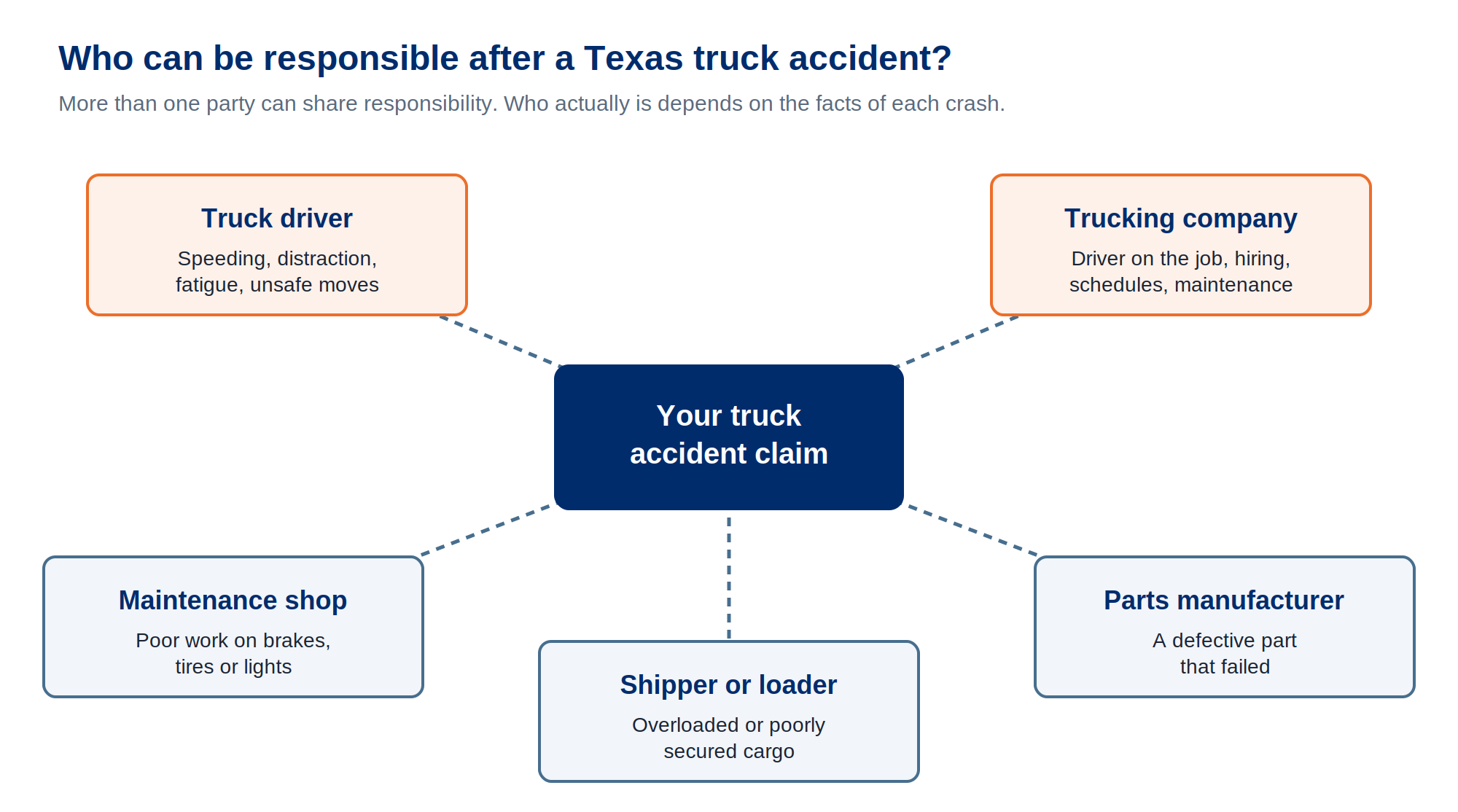
Who can be responsible for a truck accident?
Responsibility depends on the facts of each crash. These are the parties most often involved.
- The truck driver, for things like speeding, distraction, fatigue, or unsafe lane changes.
- The trucking company, which is generally responsible for a driver’s negligence on the job, and can also be responsible for its own choices, like hiring an unqualified driver, pushing unsafe schedules, or skipping maintenance.
- A maintenance or repair shop, if poor work on brakes, tires, or lights contributed.
- A shipper or cargo loader, if an overloaded or badly secured load shifted or spilled.
- A parts or truck manufacturer, if a defective part failed.
- A government entity, in limited cases involving dangerous road conditions, under strict notice rules and short deadlines.
What if I was partly at fault?
Texas uses a rule called proportionate responsibility. A jury assigns each party a percentage of fault. Under Civil Practice and Remedies Code 33.001, you can recover as long as your share is 50 percent or less, and your recovery is reduced by your share. If you were 20 percent at fault, for example, your damages are reduced by 20 percent.
Not Sure Whether You Have a Truck Accident Claim?
Many people assume they have no case because the police report points at them, or because the trucking company’s insurer sounds confident. A lawyer can look at the records and tell you where you stand, usually at no cost to you.
Free Case EvaluationWhat compensation can you recover in Texas?
Texas law sorts damages into three groups. Compensation varies based on the injuries, the evidence, and the available insurance, so no one can promise a specific amount.
| Type | What it covers | Examples |
|---|---|---|
| Economic damages | Losses you can put a number on | Medical bills, future care, lost wages, lost earning capacity, property damage |
| Noneconomic damages | Losses that are real but harder to price | Pain, mental anguish, physical impairment, disfigurement |
| Exemplary damages | Punishment for the worst conduct, not compensation | Only for gross negligence, malice, or fraud proven by clear and convincing evidence, and capped by law |
Two Texas rules shape these numbers. Medical expenses are limited to the amounts actually paid or incurred, not the full billed price. And exemplary damages are capped under Section 41.008 at the greater of $200,000, or two times economic damages plus up to $750,000 of noneconomic damages.
When a crash is fatal, certain family members can bring a wrongful death claim, and the estate can bring a separate survival claim for what the person suffered before death.
How long do you have to file?
Most Texas personal injury and wrongful death claims must be filed within two years under Civil Practice and Remedies Code 16.003. For a death, the clock usually starts on the date of death.
Some claims have much shorter notice requirements, especially claims against a city, county, or the state. And the evidence clock runs faster than the legal one. Dashcam video, black box data, and driving logs can be lost within weeks if nobody asks the company to keep them.
Should you accept the first settlement offer?
Not without understanding what it covers. Early offers often arrive before anyone knows the full cost of an injury, including future treatment or lost earning ability. Once you accept and sign a release, you usually cannot reopen the claim, even if your injuries turn out worse.
Before accepting, it helps to know:
- Whether your treatment is finished, or whether you will need more care.
- How much of your lost income, now and in the future, the offer actually covers.
- Whether every responsible party, and every insurance policy, has been identified.
- Whether health insurers or medical providers have liens that must be paid out of the settlement.
Can you handle a truck accident claim yourself?
You can. But trucking companies and their insurers often bring in investigators and lawyers early. They know the federal rules, the evidence, and the value of the claim. Many truck accident lawyers work on a contingency fee, meaning they are paid only if you recover, so a consultation usually costs nothing.
Practical steps after a truck accident in Texas
- Get medical care right away, and follow up even if you feel fine. Some injuries show up days later.
- Photograph the scene, the vehicles, and the truck’s company name and USDOT number if you can do it safely.
- Get the crash report through TxDOT’s CRIS system once it is filed.
- Look up the trucking company in the FMCSA’s SAFER company snapshot for its safety and inspection history.
- Keep every bill, receipt, and pay stub, and a simple journal of how your injuries affect your day.
- Decline recorded statements to the trucking company’s insurer until you understand your options.
Frequently asked questions
What is the statute of limitations for a truck accident in Texas?
Generally two years from the date of the injury, or from the date of death in a wrongful death case, under Civil Practice and Remedies Code 16.003. Claims against government entities can have much shorter notice deadlines.
Can I sue the trucking company and not just the driver?
Often, yes. A trucking company is generally responsible for its driver’s negligence on the job, and it can also be responsible for its own failures, like poor hiring, unsafe schedules, or skipped maintenance.
Can I recover if I was partly at fault?
Yes, if your share of responsibility is 50 percent or less. Your recovery is reduced by your percentage of fault.
How much insurance do trucking companies have to carry?
For-hire interstate carriers hauling general freight in trucks over 10,000 pounds must carry at least $750,000 in liability coverage. Some hazardous materials require $1,000,000 or $5,000,000.
Is there a cap on damages in a Texas truck accident case?
There is no general cap on economic or noneconomic damages in an ordinary truck accident case. Exemplary (punitive) damages are capped, and medical expenses are limited to amounts actually paid or incurred.
Do I need a lawyer for a truck accident claim?
You are not required to have one. But truck claims often involve federal rules, several defendants, and large insurance policies, and many lawyers offer free consultations and work on a contingency fee.
Talk to a Team Experienced in Texas Truck Accident Claims
ATAN connects injured people and families with attorneys experienced in commercial truck accident cases. Free, confidential case review, no fee unless you recover.
Sources
- Texas Civil Practice and Remedies Code 16.003: two-year limitations period.
- Texas Civil Practice and Remedies Code 33.001: proportionate responsibility.
- Texas Civil Practice and Remedies Code 41.0105: medical expenses actually paid or incurred.
- Texas Civil Practice and Remedies Code 41.008: limits on exemplary damages.
- 49 CFR 387.9: minimum financial responsibility for motor carriers.
- FMCSA, Hours of Service.

Terry Dunken is an 18 wheeler accident attorney with National Law Firm 18, which handles truck accident and motor vehicle accident cases. He reviewed this article for legal accuracy.
This content is for informational and educational purposes only. It does not constitute legal advice and does not create an attorney-client relationship. If you have been involved in a truck accident, contact a qualified attorney for advice specific to your situation.
Compensation varies based on the facts of each case, and no outcome is guaranteed. Laws and insurance requirements can change; this page reflects them as of the date above.


