

Since September 16, 2026, truck drivers hauling gasoline and diesel can legally drive up to 16 hours in a 24-hour period. The Federal Motor Carrier Safety Administration (FMCSA), the federal agency that regulates interstate trucking, issued a 90-day waiver of its normal hours-of-service rules, citing global fuel supply disruptions and record diesel prices. The waiver runs through December 16, 2026.
That means more fuel tankers on Texas highways, with drivers behind the wheel for longer stretches than the usual limits allow. This page explains what the FMCSA hours of service waiver changes, what it does not change, and what records may matter if a waivered fuel truck is involved in a serious crash.
Confirmed facts about the FMCSA fuel hauler waiver
- Issued by: The FMCSA, signed by Administrator Derek D. Barrs. Transportation Secretary Sean Duffy announced it as a step to lower fuel costs.
- Effective: September 16, 2026, through December 16, 2026.
- Who it covers: Motor carriers and drivers transporting gasoline and diesel fuel.
- What it waives: The hours-of-service limits in 49 CFR 395.3.
- New driving limit: No more than 16 hours of driving in any 24-hour period.
- Required rest: At least 6 consecutive hours in a sleeper berth every 24 hours, or at least 8 consecutive hours off duty if the truck has no sleeper berth.
- Fatigued drivers: A driver who asks for rest must be allowed to stop immediately at a safe location, and must get at least 10 consecutive hours off duty before driving again.
- Who is excluded: Carriers with a conditional safety rating, and drivers or carriers under an out-of-service order. Drivers must hold a valid CDL with the required endorsements.
- Paperwork: Drivers must carry a paper or digital copy of the waiver and show it to law enforcement on request.
- Crash reporting: Every carrier using the waiver must notify the FMCSA within 2 business days of any crash.
- Not confirmed: How many carriers or drivers are actually using the waiver, and whether any crash has been linked to it so far.
Sources: FMCSA waiver document, September 16, 2026; Overdrive, September 16, 2026; Commercial Carrier Journal, September 17, 2026; Independent Journal Review, September 16, 2026.
How does the waiver change a fuel trucker’s day?
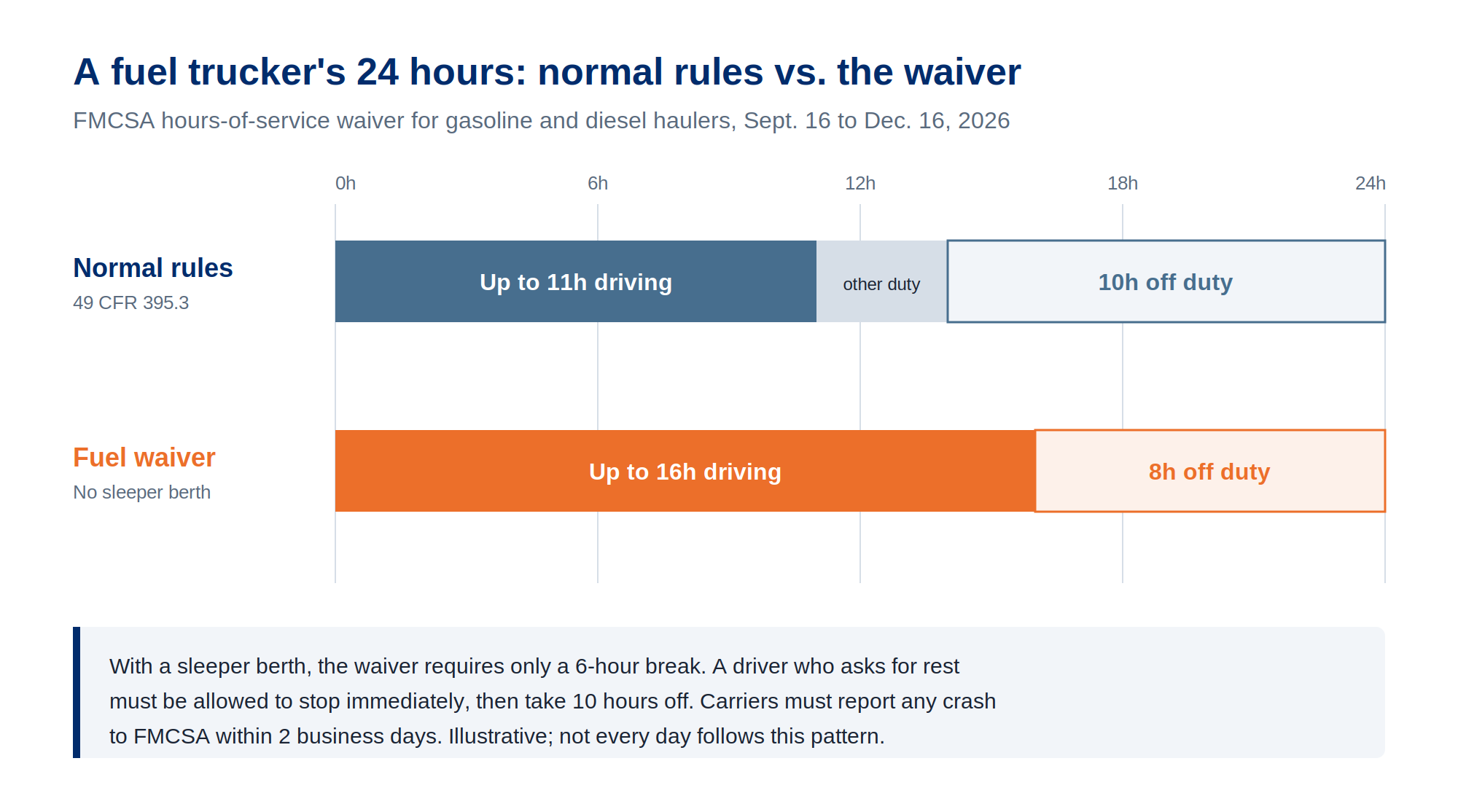
Under the normal rules in 49 CFR 395.3, a property-carrying truck driver can drive up to 11 hours, and only within a 14-hour window that starts after 10 consecutive hours off duty. The waiver replaces that with a simpler cap: 16 hours of driving in any 24-hour period.
The rest requirement shrinks too. Instead of the normal 10 hours off duty, a waivered driver needs a 6-hour sleeper berth break or an 8-hour off-duty break each day. For a family on the road beside a loaded fuel tanker, that difference is the whole story: more time driving, less time resting.
| Rule | Normal limit | Under the fuel waiver |
|---|---|---|
| Maximum driving | 11 hours | 16 hours in any 24-hour period |
| Daily rest | 10 consecutive hours off duty | 6 hours in a sleeper berth, or 8 hours off duty |
| Rest on request | Not a separate rule | Must be allowed immediately, then 10 hours off |
| Crash notice to FMCSA | Not a separate rule | Within 2 business days |
Reported timeline
- September 16, 2026The FMCSA issues the waiver, effective immediately. Overdrive and other trade outlets report it the same day.
- September 17, 2026Commercial Carrier Journal and national outlets report on the waiver and the official document.
- September 30, 2026Transport Topics reports on the waiver as diesel supplies tighten.
- December 16, 2026The waiver is set to expire unless the FMCSA extends or ends it.
What did federal officials say?
The FMCSA said the waiver responds to global supply disruptions and an expected rise in demand for gasoline and diesel in the late summer and fall. Secretary Duffy framed it as a way to lower fuel costs. Coverage at the time put the U.S. average diesel price at $6.29 a gallon, according to Independent Journal Review.
The waiver itself keeps some safety guardrails, including the rest-on-request rule and the 2-day crash notice. Not everyone was reassured. One commenter quoted by Independent Journal Review said pushing drivers to 16 hours “raises real safety concerns on the highways.”
What remains unanswered
- How many fuel carriers operating in Texas are using the waiver.
- Whether the FMCSA will publish the crash notices carriers send it under the waiver.
- Whether the waiver will be extended past December 16.
- How carriers are tracking driver fatigue when shifts run longer than the normal limits.
Hit by a Fuel Tanker or Fuel Truck This Fall?
A federal waiver can let a fuel hauler drive longer, but it does not excuse a driver who was too tired to drive safely, or a carrier that pushed one. If you or someone you love was hurt in a crash with a gasoline or diesel truck, a lawyer can check whether the waiver was in play and what the driver’s logs show.
Free Case EvaluationWhat records may matter after a crash with a waivered fuel truck?
A waiver changes the hour limits. It does not change the basic duty every truck driver and trucking company owes everyone else on the road: to drive and operate safely. Separate federal rules still bar anyone from driving a commercial truck while too fatigued to drive safely, under 49 CFR 392.3.
- The carrier’s crash notice to the FMCSA. Under the waiver, a carrier must report any crash to the agency within 2 business days. That notice is a new record that does not exist for most truck crashes.
- The driver’s copy of the waiver. Drivers must carry it. Whether the driver had it, and whether the carrier was even eligible, can both matter.
- The carrier’s safety rating. Carriers with a conditional rating are excluded. A carrier that used the waiver while ineligible was not covered by it at all.
- Electronic logging device data. The waiver lists 49 CFR 395.3 as the rule it waives. Driving logs under 49 CFR Part 395 can show exactly how long the driver had been driving and when the last rest break was.
- Requests for rest. Dispatch messages, texts and call logs can show whether a driver asked to stop and whether the carrier allowed it.
- Post-crash drug and alcohol testing. Serious crashes can trigger testing requirements under 49 CFR 382.303, depending on what happened.
- The truck’s black box. Engine control module data can show speed and braking in the seconds before a crash.
Why the waiver does not settle who is responsible
Legal driving time and safe driving are not the same thing. A driver can be inside the 16-hour limit and still be too tired to drive safely. A trucking company can follow the waiver on paper and still be responsible if it pressured a driver to keep going, ignored a request for rest, or put a fatigued driver on the road.
In Texas, a trucking company can share legal responsibility for a crash caused by its driver while on the job, under standard employer liability rules. A carrier’s own choices, like dispatch schedules and fatigue policies, can matter too. We have no information that any specific crash has been linked to this waiver.
Practical steps after a crash with a fuel truck
- Get the crash report through TxDOT’s CRIS system once it is filed.
- Note the company name and USDOT number on the truck’s door, then look up the carrier’s safety record in the FMCSA’s SAFER company snapshot.
- Read the waiver yourself. The full text is on the FMCSA website.
- Ask about preserving logs and dispatch records early. Driving logs, texts and engine data can be lost or overwritten if nobody asks for them.
- Get medical care and keep every record, even if you feel fine at the scene.
- Decline recorded statements to the trucking company’s insurer until you understand your options.
Frequently asked questions
Can fuel truck drivers really drive 16 hours a day right now?
Yes, if they qualify. From September 16 through December 16, 2026, eligible drivers hauling gasoline or diesel can drive up to 16 hours in any 24-hour period under an FMCSA waiver, with a required 6-hour sleeper berth break or 8-hour off-duty break each day.
Does the waiver protect a trucking company if its driver causes a crash?
No. The waiver changes hour limits, not the duty to drive safely. Federal rules still bar driving while too fatigued to drive safely, and a carrier can still be responsible for a crash caused by its driver.
Which carriers cannot use the waiver?
Carriers with a conditional safety rating, and any carrier or driver under an out-of-service order. Drivers also need a valid CDL with the right endorsements.
Does the waiver apply to trucks that only drive inside Texas?
The FMCSA regulates interstate trucking, and coverage describes this waiver as covering interstate fuel haulers. Trucks that operate only within Texas generally follow Texas’s own intrastate hours rules, which this federal waiver does not change.
What happens if a waivered fuel truck crashes?
The carrier must notify the FMCSA within 2 business days. That notice, the driver’s logs, and any dispatch messages can all become important records in a later claim.
How long do I have to file a claim after a truck crash in Texas?
Most Texas personal injury and wrongful death claims must be filed within two years under Civil Practice and Remedies Code 16.003. That is an outside limit. Logs, dispatch records and engine data can disappear much sooner.
Talk to a Team Experienced in Tanker and Fatigued Driver Cases
ATAN connects injured people and families with attorneys experienced in commercial truck accident cases, including crashes where hours of service and driver fatigue are in question. Free, confidential case review, no fee unless you recover.
Sources
- Federal Motor Carrier Safety Administration, “Hours of Service Waiver: Transportation of Fuel”, effective September 16, 2026.
- Overdrive, “FMCSA waives HOS regs for gas, diesel haulers”, September 16, 2026.
- Commercial Carrier Journal, “FMCSA eases hours-of-service for gas, diesel haulers”, September 17, 2026.
- Independent Journal Review, “US extends fuel truck driver shifts to avert supply delays amid record diesel prices”, September 16, 2026.
- Transport Topics, “FMCSA issues fuel transport waiver as diesel supplies tighten”, September 30, 2026.
- 49 CFR 395.3: maximum driving time. 49 CFR 392.3: ill or fatigued operators. 49 CFR 382.303: post-accident testing.
- Texas Civil Practice and Remedies Code Section 16.003 (limitations).

Terry Dunken is an 18 wheeler accident attorney with National Law Firm 18, which handles truck accident and motor vehicle accident cases. He reviewed this article for legal accuracy.
This content is for informational and educational purposes only. It does not constitute legal advice and does not create an attorney-client relationship. If you have been involved in a truck accident, contact a qualified attorney for advice specific to your situation.
Facts on this page come from the FMCSA’s published waiver and reporting by Overdrive, Commercial Carrier Journal, Independent Journal Review and Transport Topics. Nothing here states that any person or company is liable for any crash. America’s Truck Accident Network is not affiliated with the FMCSA.


